
Introduction
By mid-year, most companies face the same uncomfortable realization: growth didn’t go exactly as planned.
Targets shift. Costs creep up. Teams feel stretched. And suddenly, the question becomes urgent—do we hire more people, or rethink how work gets done?
This is where outsourcing is no longer just an option—it becomes a strategic decision. In 2026, smart companies aren’t simply adding headcount. They’re rethinking structure, prioritizing stability, and optimizing for business efficiency.
Because scaling isn’t just about doing more.
It’s about doing it better—with the right systems behind it.

The Mid-Year Reality: Why Growth Starts to Break Systems
The Hidden Bottleneck: Operations, Not Revenue
On paper, many businesses are growing. Revenue is up. Demand is steady.
But internally, it’s a different story:
- Customer response times slow down
- Backlogs start piling up
- Leadership gets pulled into day-to-day tasks
This isn’t a hiring problem—it’s a systems problem.
Adding more employees without fixing operational gaps often leads to:
- Increased overhead
- Inconsistent output
- More management complexity
By mid-year, these inefficiencies become impossible to ignore.
Hiring in 2026: Still Necessary, But Not Always Scalable
When Hiring Makes Sense
Hiring is still critical for:
- Leadership roles
- Core strategic functions
- Culture-driving positions
These are roles that require deep integration into your business.
Where Hiring Falls Short Mid-Year
However, traditional hiring comes with challenges—especially mid-year:
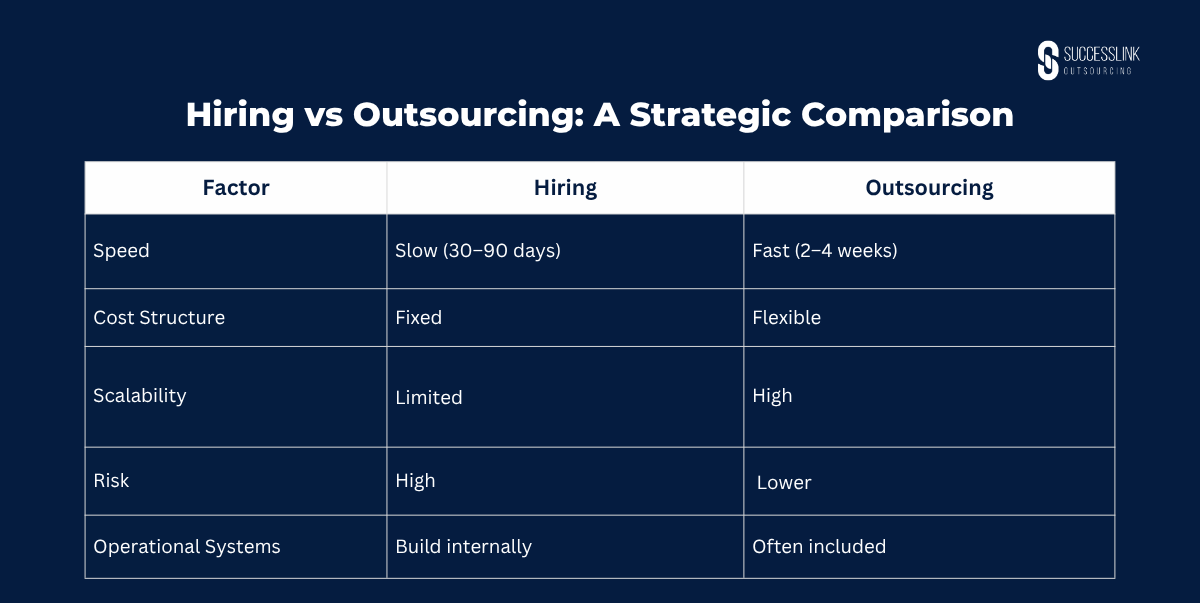
- Long ramp-up time (30–90+ days)
- High fixed costs (salary, benefits, taxes)
- Limited flexibility
- Increased risk if projections change
Scenario:
A SaaS startup hires 3 in-house support agents in June. By August, ticket volume fluctuates, and two agents are underutilized—yet payroll remains fixed.
Hiring solves capacity, but not always efficiency.

Outsourcing in 2026: From Cost-Cutting to Growth Infrastructure
What Changed?
Outsourcing is no longer about cheap labor.
In 2026, it’s about:
- Building operational infrastructure
- Creating scalable systems
- Supporting growth without adding friction
Smart companies now use outsourcing to stabilize operations before scaling further.
Why Smart Companies Are Choosing Outsourcing Mid-Year
1. Immediate Impact Without Long Ramp-Up
Outsourced teams can often be deployed within weeks—not months.
This means:
- Faster response to operational gaps
- Immediate relief for overwhelmed teams
- Minimal disruption to existing workflows
2. Flexibility That Matches Business Reality
Mid-year is unpredictable. Forecasts change.
Outsourcing allows businesses to:
- Scale teams up or down
- Adjust based on demand
- Avoid long-term financial commitments
This directly improves business efficiency.
3. Cost Structure That Supports Growth
Instead of fixed overhead, outsourcing offers:
- Predictable monthly costs
- Lower total cost per role
- No additional HR or infrastructure burden
This frees up capital for:
- Marketing
- Product development
- Strategic hires
4. Focus on Core Functions
When non-core tasks are outsourced, leadership regains focus.
Common functions outsourced:
- Customer support (voice & non-voice)
- Back-office operations
- Administrative support
- Data management
Result:
Leaders spend more time on growth, not firefighting.
5. Built-In Systems and Process Discipline
One overlooked advantage of outsourcing is structure.
Experienced outsourcing partners bring:
- Standardized workflows
- Performance tracking
- Accountability systems
This strengthens overall stability—something most fast-growing companies lack.
The takeaway isn’t “replace hiring.”
It’s this:
Use hiring for strategy. Use outsourcing for execution and scalability.
The Hybrid Model: What Smart Companies Are Actually Doing
The most effective companies in 2026 aren’t choosing one or the other.
They’re combining both.
A Modern Structure Looks Like This:
- In-house team: Leadership, strategy, high-level functions
- Outsourced team: Execution, support, repeatable processes
Example:
A debt settlement company keeps negotiators and leadership in-house, while outsourcing:
- Customer service
- Document processing
- Admin support
This creates:
- Operational stability
- Better business efficiency
- Faster scalability without burnout
How to Know If It’s Time to Outsource Mid-Year
If you’re experiencing any of these, it’s time to consider outsourcing:
- Your team is consistently overwhelmed
- You’re delaying growth due to operational gaps
- You’re involved in tasks you shouldn’t be handling
- Hiring feels too slow or too expensive
- Your systems can’t keep up with demand
These are not just pain points—they are signals.
Common Misconceptions About Outsourcing
“We’ll lose control”
In reality, structured outsourcing increases visibility through reporting and KPIs.
“Quality will drop”
With the right partner, quality often improves due to specialization and training.
“It’s only for large companies”
SMBs and startups benefit the most because they gain access to systems they couldn’t build alone.
Conclusion: Stability First, Then Scale
The companies winning in 2026 aren’t the ones hiring the fastest.
They’re the ones building the strongest foundations.
Outsourcing isn’t a shortcut—it’s a strategy.
A way to create stability, improve business efficiency, and scale with intention.
Because growth without structure leads to chaos.
But growth built on systems? That’s sustainable.
Call to Action
If your business is feeling the pressure of mid-year growth, it may not be a hiring issue—it may be an operational one.
Let’s fix that.
Book a discovery call with our team and explore how outsourcing can help you build a more stable, scalable business.
