
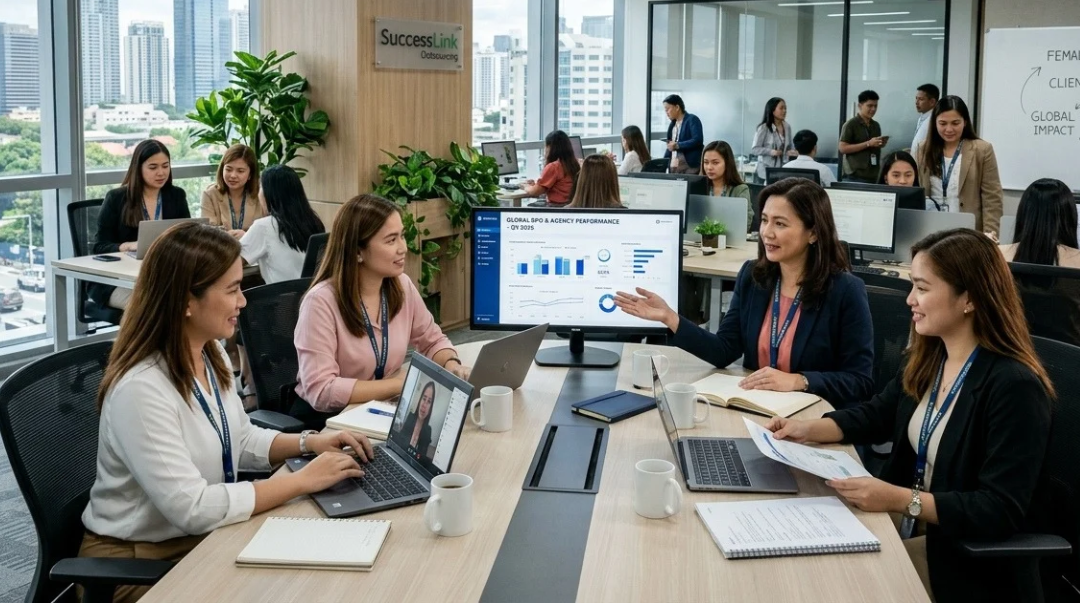
Women are building some of the most adaptable businesses in the global outsourcing ecosystem. From BPO founders and agency owners to operations leaders and technology entrepreneurs, female leaders are helping businesses rethink how talent, technology, and operational support come together.
As National Women’s Small Business Month highlights the contributions of women entrepreneurs, it is also an opportunity to look at an industry where women have long played an important role: global outsourcing.
The BPO and outsourcing industry is changing rapidly. Technology is reshaping workflows, clients are demanding more specialized expertise, and businesses are moving away from traditional “staff augmentation” models toward strategic partnerships.
Female-led BPOs and agencies are part of that evolution—building companies around people, relationships, operational excellence, and the ability to adapt.

The Growing Influence of Women in Outsourcing
Outsourcing is often discussed through the lens of technology, labor markets, and cost efficiency. But behind many successful outsourcing businesses are people who understand something equally important: business is ultimately about people and relationships.
Women entrepreneurs across the outsourcing ecosystem are building businesses that connect global talent with companies that need specialized skills, operational support, customer service, technology, marketing, and administrative expertise.
Their leadership can be seen across different parts of the industry, including:
- Business process outsourcing and customer experience
- Virtual assistance and administrative support
- Digital marketing agencies
- Technology and IT services
- Recruitment and staffing
- Finance and accounting support
- Healthcare support services
- E-commerce operations
- Creative and professional services
This diversity reflects how much the outsourcing industry has evolved.
It is no longer simply about moving repetitive tasks to another location. Modern outsourcing is increasingly about accessing expertise, building capacity, improving systems, and creating a more flexible operating model.
Why Female Entrepreneurs Are Making an Impact
There is no single leadership style that defines successful women entrepreneurs. However, many female founders in the outsourcing and agency space have built businesses around several characteristics that are particularly valuable in a people-driven industry.
1. Relationship-Centered Leadership
Outsourcing requires trust.
A client is not simply handing over a task. In many cases, they are giving an external team access to customers, business information, internal processes, and critical parts of their operation.
Successful leaders understand that strong relationships are built through communication, transparency, and accountability.
Female entrepreneurs have built many businesses around this relationship-first approach, recognizing that long-term partnerships are often more valuable than one-time transactions.
2. Building Around Talent
People are the foundation of the outsourcing industry.
Technology can automate processes and artificial intelligence can accelerate certain tasks, but skilled professionals remain essential for decision-making, communication, problem-solving, and customer relationships.
Female-led BPOs and agencies are contributing to a broader shift toward viewing offshore and distributed talent as a strategic resource rather than simply a lower-cost alternative.
The question becomes:
“What can this team help us accomplish?”
rather than simply:
“How much can this team save us?”
That shift creates opportunities for businesses and employees alike.
3. Adaptability in a Changing Market
Outsourcing has changed significantly over the past decade.
Clients today may need a combination of customer support representatives, virtual assistants, marketing specialists, software developers, analysts, and AI-enabled workflows.
Successful outsourcing entrepreneurs have had to adapt alongside their clients.
That means expanding service offerings, investing in technology, developing new talent, and continuously asking how their teams can solve evolving business problems.
For women entrepreneurs, this ability to build, adapt, and reinvent can be particularly powerful when operating in competitive markets.
Profiles Worth Celebrating
National Women’s Small Business Month is also a chance to recognize the women who have helped shape the broader outsourcing and technology ecosystem.
Several entrepreneurs provide useful examples of what leadership can look like in different parts of the industry.
Sheila Lirio Marcelo — Caregiving and Technology
Sheila Lirio Marcelo founded Care.com, building a technology platform around one of the world’s most fundamentally human needs: care.
Her entrepreneurial journey demonstrates how technology and people-centered services can work together.
While Care.com is not a traditional BPO, Marcelo’s story is relevant to the broader outsourcing conversation because it demonstrates how entrepreneurs can build scalable businesses around service-based industries and human expertise.
Diane von Furstenberg? No—Look Beyond the Traditional Agency Model
One important lesson when discussing female entrepreneurship in outsourcing is that leadership does not always fit neatly into a traditional BPO definition.
Women are building companies across adjacent sectors—technology, professional services, staffing, consulting, marketing, and operations—that increasingly overlap with the modern outsourcing ecosystem.
This matters because the future of outsourcing is becoming less about a single industry category and more about how businesses access capabilities.
A company may work with an external marketing agency, a technology partner, a customer experience team, and a virtual operations team—all functioning as part of the same extended organization.
Female entrepreneurs are building businesses across these boundaries.
Melinda Gates and the Broader Entrepreneurial Ecosystem
Melinda French Gates offers another example of how women’s entrepreneurship and investment can influence the broader business ecosystem.
Her work supporting women entrepreneurs and expanding access to capital highlights a critical issue: building more women-led businesses requires more than celebrating successful founders. It also requires creating pathways for women to access funding, networks, mentorship, and opportunities.
That is especially relevant to small businesses, where access to resources can determine whether a promising company remains small or has the opportunity to scale.
The goal isn’t simply to have more women-owned businesses. It’s to create an ecosystem where women-led businesses can build durable, scalable companies.
The Philippines: A Powerful Part of the Global Outsourcing Story
The Philippines deserves particular attention in any conversation about women and global outsourcing.
The country has become an important destination for customer service, business process outsourcing, virtual assistance, technology, and professional services.
Women have played significant roles throughout this ecosystem—as employees, managers, entrepreneurs, team leaders, and business owners.
For many Filipino women, the outsourcing industry has created pathways into professional careers, leadership positions, and entrepreneurship.
It has also helped demonstrate that global businesses can build high-quality teams across borders when the right systems, training, communication, and management structures are in place.
This is one reason the future of outsourcing should not be defined purely by geography.
Talent can be global. Leadership can be global. And opportunity can be global.
From “Outsourcing Vendor” to Strategic Partner
The rise of female-led BPOs and agencies also reflects a larger change in how companies think about outsourcing.
Traditional outsourcing models often focused on specific tasks.
A company needed customer service representatives, so it hired a BPO.
A company needed marketing support, so it hired an agency.
A company needed administrative help, so it hired virtual assistants.
Today, businesses increasingly need something more integrated.
They need teams that understand the company’s processes, technology, customers, goals, and operating model.
That creates an opportunity for outsourcing companies to become operational infrastructure partners rather than simply service vendors.
The distinction is important.
A vendor completes a defined task.
A strategic partner helps build the systems and capacity that allow a business to operate more effectively.
What This Looks Like in Practice
Imagine a growing SaaS company that suddenly doubles its customer base.
Its challenge isn’t simply finding more people.
It may need:
- Customer support coverage
- Better ticket management
- Knowledge-base development
- Data reporting
- Administrative support
- Technical troubleshooting
- Process documentation
- Quality assurance
- AI-assisted workflows
Instead of hiring several full-time employees immediately, the company could build a coordinated external team that provides these capabilities while internal leadership remains focused on product, customers, and growth.
That is where modern outsourcing becomes more strategic.
What Businesses Can Learn From Female-Led Companies
Regardless of who owns the business, there are several lessons entrepreneurs can take from successful women-led companies across the outsourcing ecosystem.
Build Relationships Before Transactions
Long-term partnerships are rarely created by selling a service and disappearing after the contract is signed.
Communication, responsiveness, transparency, and shared goals matter.
Invest in People
The best technology cannot compensate for an unprepared team.
Training, leadership development, quality assurance, and career growth can directly influence service quality and client retention.
Design Systems That Scale
Growth becomes difficult when every process depends on one person remembering what to do.
Document workflows. Define responsibilities. Establish quality standards. Create reporting systems.
Good systems give people room to perform at their best.
Stay Curious
Markets change.
The skills clients need today may not be the skills they need three years from now.
Entrepreneurs who continuously learn, test new technologies, listen to customers, and improve their operating models are better positioned to adapt.
Women and the Future of the Global Outsourcing Industry
The next chapter of outsourcing will likely look very different from the BPO model many businesses knew a decade ago.
Artificial intelligence will continue changing workflows. Distributed teams will become more common. Businesses will seek specialized talent instead of large generic teams. And clients will increasingly expect outsourcing partners to contribute ideas—not simply execute instructions.
That creates room for a new generation of entrepreneurs.
Female founders and executives can play an important role in that evolution by building companies that combine human expertise, technology, operational discipline, and strong relationships.
The opportunity is not just to create more outsourcing companies.
It is to create better ones.
Companies that give clients access to quality talent.
Companies that invest in their people.
Companies that build systems instead of relying on workarounds.
And companies that help growing businesses become more stable, agile, and scalable.
How to Build a More Inclusive Outsourcing Ecosystem
Celebrating successful female entrepreneurs is important, but recognition should be paired with action.
Businesses can contribute to a stronger entrepreneurial ecosystem by:
- Supporting women-owned vendors and service providers
- Creating mentorship opportunities
- Expanding access to leadership development
- Providing flexible career pathways
- Investing in professional training
- Building diverse leadership teams
- Connecting entrepreneurs with business networks
- Creating opportunities for women to move from employees to managers and eventually founders
For outsourcing companies, this can begin internally.
Leadership pipelines, skills development, mentorship, and opportunities for advancement can help talented professionals build long-term careers rather than simply fill positions.
That is how an outsourcing company can become more than a workforce provider.
It can become a place where people build careers, develop leadership skills, and eventually create businesses of their own.
Beyond Outsourcing: Building Businesses That Last
The global outsourcing industry is ultimately a story about connection.
A business in California can work with a team in the Philippines. A startup in London can access technology talent across multiple countries. A growing company can build operational capacity without building every function internally.
But successful global partnerships require more than distance and technology.
They require trust.
They require systems.
And they require people who understand how to turn talent into consistent business outcomes.
Female entrepreneurs across the outsourcing and agency ecosystem are contributing to that future every day.
Their stories remind us that entrepreneurship isn’t only about building a company. It’s about creating opportunities, solving problems, developing people, and building something capable of lasting.
As we recognize National Women’s Small Business Month, that may be the most important lesson of all:
The future of outsourcing isn’t just about where the work gets done. It’s about who is building the systems, leading the teams, and creating the businesses that make global work possible.
Ready to Build a More Scalable Operating Model?
Whether you need customer experience support, back-office capacity, technical talent, or specialized operational expertise, the right outsourcing model can give your business more than additional hands.
It can give you the people, systems, and capacity needed to grow with greater stability.
Book a discovery call with SuccessLink Outsourcing to explore how a flexible, system-driven team can become part of your business infrastructure.
