

Introduction: The Problem Most Businesses Don’t See Coming
Growth is exciting—until it breaks your operations.
Many businesses scale demand faster than they scale their systems. What starts as a few missed emails or delayed onboarding quickly turns into operational chaos. Teams get overwhelmed, processes become inconsistent, and leadership gets pulled back into day-to-day execution.
This is where outsourcing has traditionally stepped in—but not always effectively.
Today, a new model is emerging: the Operational Infrastructure Company. And for businesses serious about sustainable growth, it’s becoming not just an option—but a necessity.
What Is an Operational Infrastructure Company?
An Operational Infrastructure Company goes beyond traditional outsourcing.
Instead of simply providing staff to complete tasks, it builds the systems, processes, and support structure that allow your business to scale efficiently.
Traditional Outsourcing vs Operational Infrastructure
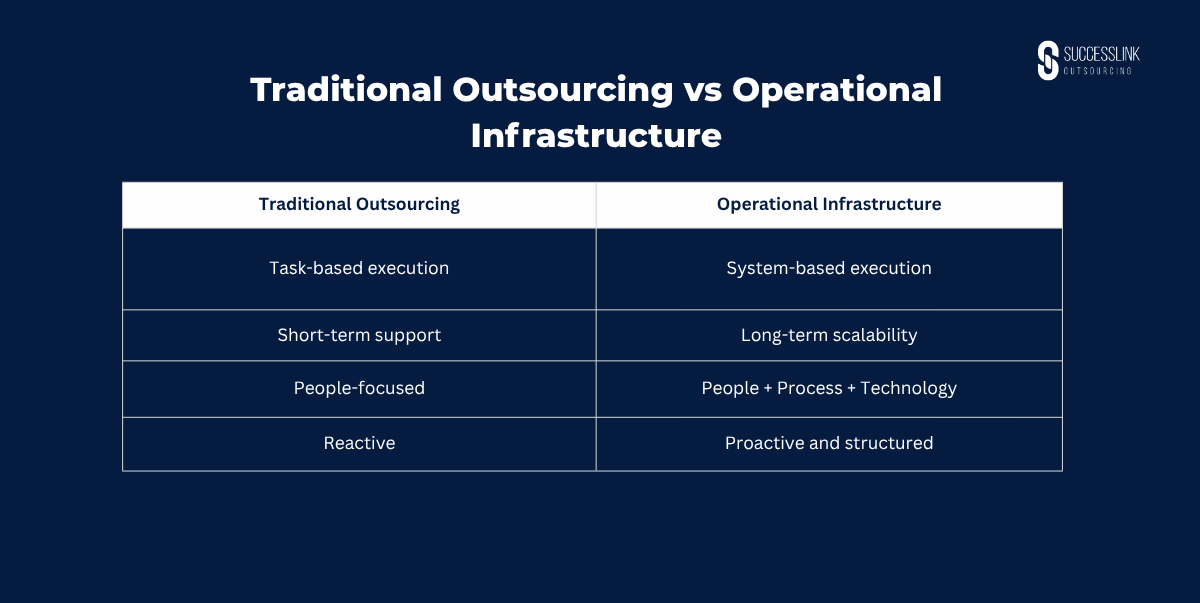
In short:
Outsourcing fills gaps. Operational infrastructure eliminates them.
Why Traditional Outsourcing Falls Short
For years, outsourcing has been positioned as a cost-saving solution. While it can reduce expenses, it often fails to address the deeper issue: lack of operational structure.
Common Challenges Businesses Face
- Inconsistent workflows
- High dependency on key individuals
- Poor communication between teams
- Lack of standardized processes
- Difficulty scaling without breaking systems
Mini Scenario
A growing debt relief company hires offshore agents to handle customer service.
At first, things improve.
But soon:
- Different agents follow different processes
- Client onboarding becomes inconsistent
- Errors increase
- Leadership spends more time managing than growing
The problem wasn’t the people.
The problem was the absence of infrastructure.
The Rise of Operational Infrastructure in Outsourcing
As businesses become more complex, the expectations from outsourcing partners have evolved.
Companies no longer just need:
- Virtual assistants
- Customer service reps
- Back-office support
They need:
- Integrated systems
- Standardized workflows
- Scalable operational frameworks
This shift is redefining what outsourcing means.

Outsourcing Is No Longer About Cost—It’s About Capability
Modern businesses are asking:
- Can this partner help me scale without breaking?
- Can they create consistency across my operations?
- Can they build systems my business can rely on?
That’s where operational infrastructure companies lead.
Core Components of an Operational Infrastructure Company
To truly support scalable growth, an operational infrastructure partner focuses on three pillars:
1. People (Right Talent, Right Structure)
Not just hiring—but structuring teams for efficiency.
- Role clarity and accountability
- Specialized vs. generalist roles
- Performance tracking systems
2. Process (Standardization & Optimization)
Documented and repeatable workflows that remove guesswork.
- SOP creation and implementation
- Workflow automation
- Quality control systems
3. Technology (Tools That Enable Scale)
The backbone that connects everything.
- CRM integration
- Communication platforms
- Reporting dashboards

Why Operational Infrastructure Is the Future of Scaling Businesses
1. It Creates Stability Before Growth
Most companies chase growth first.
But without stability, growth leads to breakdowns.
Operational infrastructure ensures:
- Consistency in execution
- Predictable outcomes
- Reduced operational risk
2. It Frees Leadership from Operations
Founders and executives often get stuck managing tasks instead of leading strategy.
With the right infrastructure:
- Daily operations run independently
- Decision-making becomes data-driven
- Leaders can focus on growth, not firefighting
3. It Enables Scalable Expansion
Whether you’re adding clients, launching new services, or entering new markets—systems make scaling possible.
Without infrastructure:
- Growth = stress
With infrastructure:
- Growth = controlled expansion
4. It Improves Customer Experience
Consistency is everything.
Operational infrastructure ensures:
- Faster response times
- Standardized client interactions
- Reliable service delivery
This directly impacts retention and reputation.
Who Needs an Operational Infrastructure Company?
This model is especially valuable for:
Startups
- Building systems early to avoid chaos later
Scaling SMBs
- Transitioning from founder-led operations to structured teams
Enterprise Teams
- Optimizing inefficiencies across departments
Industries That Benefit Most
- Debt settlement companies
- Property management firms
- E-commerce businesses
- Professional services
Internal Linking Suggestion: Link to a case study page showcasing a “Debt Relief Company” or similar client success story.
What to Look for in an Operational Infrastructure Partner
Not all outsourcing providers are built the same.
Here’s what sets true infrastructure partners apart:
Key Qualities
- System-first approach (not just staffing)
- Hands-on leadership involvement
- Experience in your industry
- Scalable frameworks, not one-off solutions
- Focus on long-term partnership
Red Flags to Avoid
- Vague processes
- No documentation or SOPs
- High turnover without accountability
- Purely cost-driven positioning
The Bottom Line: From Outsourcing to Infrastructure
The conversation is changing.
Outsourcing is no longer just about:
- Saving money
- Delegating tasks
It’s about:
- Building systems
- Creating stability
- Enabling growth
The companies that win are not the ones that scale the fastest—
but the ones that scale the smartest.
Ready to Build Your Operational Infrastructure?
If your business is growing—but your operations are struggling to keep up—it’s time to rethink your approach to outsourcing.
At SuccessLink Outsourcing, we don’t just provide support.
We help you build the operational backbone your business needs to scale with confidence.
From people to process to technology, we create systems designed for:
- Stability
- Integration
- Long-term growth
Let’s build your infrastructure.
Contact SuccessLink Outsourcing today to learn how we can help you transition from outsourcing tasks to building a scalable operational ecosystem.
